It’s like this:
I would LOVE the UK to have a human spaceflight programme. I would LOVE the UK to lead the way in space exploration. I would LOVE for people around the world to look at our country and see that we are investing in science, technology and inspiring a new generation of engineers. So why am I not sold on SKYLON?
SKYLON could be the answer – a space plane that can go from runway to orbit and land back on a runway again. A fully reusable vehicle which promises cheaper launch costs and a more reliable launch system, and it’s being developed here in the UK. The air-breathing SABRE engines that Reaction Engines are developing are the key to this, and according to Mark Hempsell, who’s worked for Reaction Engines for many years, the feeling inside the project is that it’s “achingly close to being realised”.
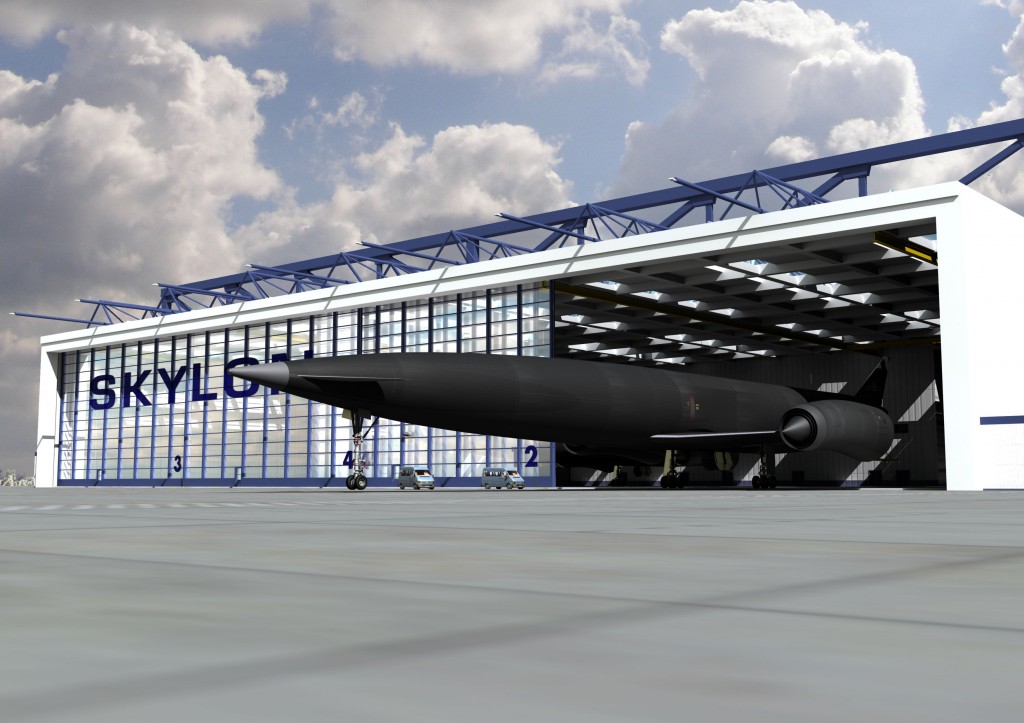
At a recent talk at the British Interplanetary Society, Hempsell, (who is leaving Reaction Engines to work for his own company, Hempsell Aeronautics) said we’re at an “absolutely unique point in astronautical history”. He went on to explain how SKYLON’s 4.8x13m payload bay could take 15 tonnes to Low Earth Orbit (300km) and because it’s reusable it will bring down the cost of reaching space. Cost being the fundamental thing holding back astronautics he explained.
He went through various factors, looking at the short- and long-term hopes for SKYLON. For example, in the short-term, he said that SKYLON will be fully commercial at lower-than-current launch costs (i.e. no tax-payer subsidy required to make up the launch cost). In the long term they are looking at around $10 million per launch.
Hempsell said that SKYLON will be more reliable than current launches, and since it has the option of aborting a mission and returning to Earth if there is a failure, he reckons there would be just a 1 in 20,000 chance of not getting your satellite successfully in orbit, or safely back to Earth in case of a problem. In the long-term they are looking at having reliability levels that match those of aircraft.
Availability is another key selling point. In the short-term, SKYLON could be available in a matter of months, and in the long-term they are hoping for it to be available in hours (if required – not as standard!).
So which market are they aiming for with SKYLON?
In the short-term Hempsell expects it to be a simple replacement for expendable satellite launchers, but the long-term ambitions are much grander. He says it’s a game changer, disruptive technology that could lead to a new age of space exploration – allowing people to realise those old dreams of people living in space.
The optimism continued as Hempsell explained that SKYLON can meet the requirements of the next generation European launcher. He reckons they can capture the market that ESA has. “This is a perfect match for what ESA thinks it will be doing until 2050” he says, adding that although ESA has no human spaceflight requirement at this stage, SKYLON will be sold to people who do, in the 2020s.
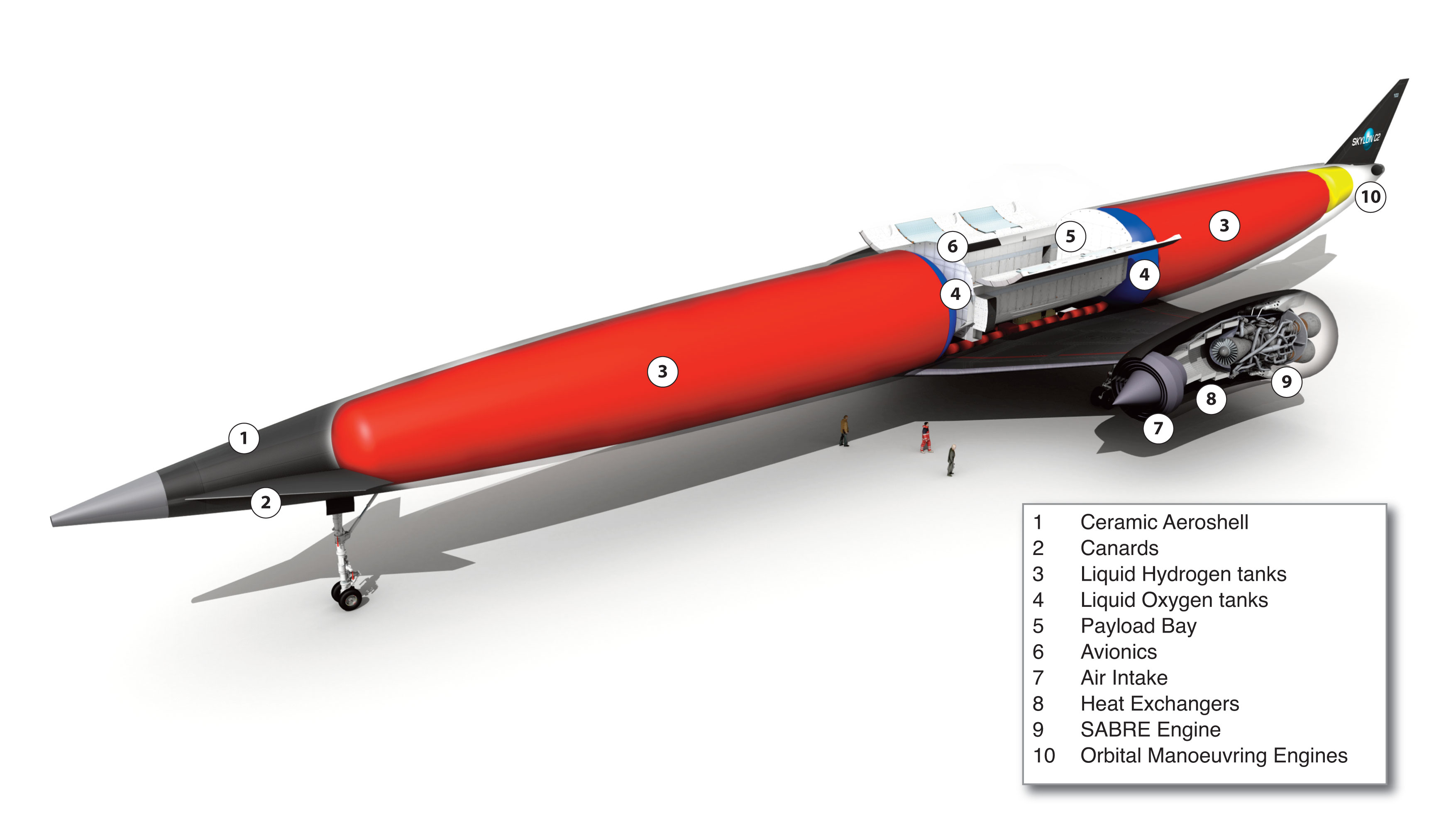
He claims that SKYLON could fly to the ISS with 11.5 tonnes of payload (or 10.5 tonnes if you allow for an attachment interface – which is rather crucial if you think about it!).With a crew/cargo combination you’d be looking at being able to send up an exchange crew of three to four people, plus around two tonnes of cargo.
They are also looking at a “personnel and logistics module” that could sit in the payload bay and take around 7.8 tonnes, including a crew, consumables and around 24 passengers into space. They expect something like that to be available when they’re ready to launch.
Here’s a (somewhat outdated) video explaining the module:
SKYLON Personnel & Logistics Module from Reaction Engines Ltd on Vimeo.
So that’s the satellite launch and space tourism markets covered, what about its potential for furthering exploration? “Project Troy” was a study looking at whether SKYLON (the old version, rather than new D mark) could be useful for a Mars mission. The study “proved” that SKYLON can launch a manned mission to Mars. They looked at building spacecraft in LEO and boosting them to Mars with Hydrogen and Oxygen fuelled stages. It suggests a fleet of three craft, each with six astronauts. Fascinating. Must find out more.
Project Troy was carried out to ensure that SKYLON is future-proofed says Hempsell. Thinking ahead to possible future scenarios is a smart move, though whether I would agree it is possible to “prove” a vehicle that as yet doesn’t exist (and airframe design is not finalised) is capable of a Mars mission, I’m not sure. “SKYLON will not be a block to realising customers’ dreams” say Hempsell. It’s a bold claim.
He talked us through the concept design of the “Fluyt” stage, which was worked on by Simon Feast. This could deliver 15 tonnes to GEO, and around 12 tonnes to lunar orbit apparently.
They also looked at a post-ISS scenario, in which they envision 14 space stations situated from LEO to the lunar surface, with 104 people in space, including a space hotel.
With one operational SKYLON flying twice a week, he told us it would be possible to build a space station in LEO in just 6 weeks, and a GEO/Lunar station in 18 weeks. With two SKYLONs you could build the whole 14 station infrastructure in less than three and a half years!
It’s exciting stuff. Imagine that! – building a space station in just six weeks – with a UK space vehicle! That would certainly put us on the map as a serious space-faring nation.
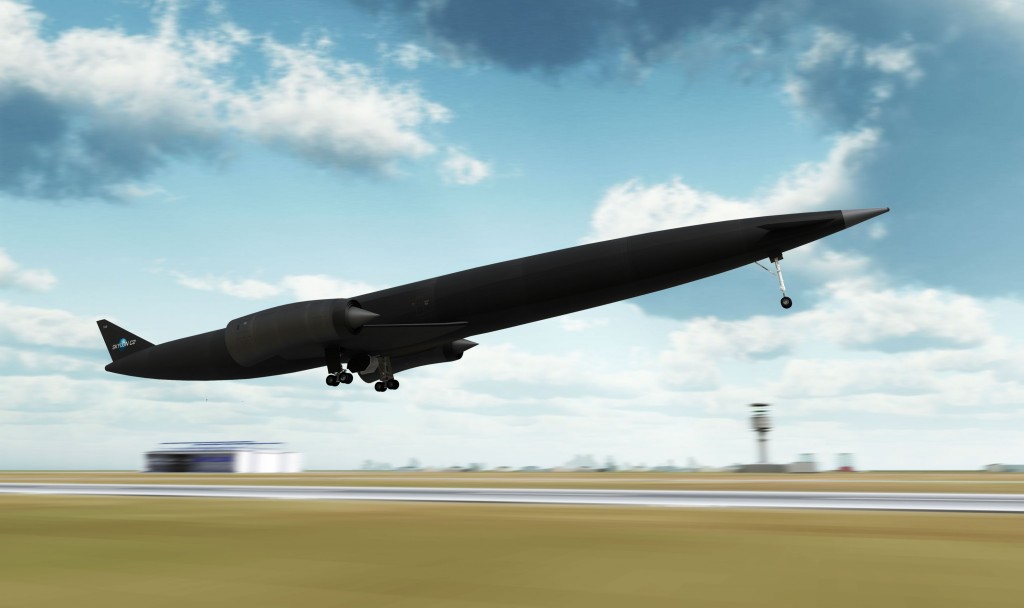
So why am I not rejoicing? Why am I not leaping about and extolling the virtues of this vehicle? If it can do all of the above it really would be a game changer. What’s my problem? (Apart from the fact I think it looks like an evil whale harpoon.)
My problem is that it doesn’t actually exist.
SKYLON, the thing that we keep hearing about, is not the main focus for Reaction Engines. In fact, they are not even going to create the airframe for it, someone else will. The idea for producing SKYLON is to create a customer for the engines that Reaction Engines are making. Their air-breathing engines might well be game-changing, but we’re a long way away from all the things that Hempsell was so excited to talk about.
He himself admits that the devil is in the details. He mentions an issue with docking mechanisms – they don’t want to change the one that is designed for Skylon, but that would mean satellites would have to add a special SKYLON interface mechanism in order to work with the vehicle. This would add an extra 5-10kg to the satellite says Hempsell. It might not sound much, but I’m pretty sure it’s no simple undertaking.
For crew/cargo delivery to the ISS to be fully effective, you would require a docking system with a hatch big enough to get equipment racks through. Apparently the current ISS hatches can’t do this and you have to go through berthing modules. (Correct me if this is wrong, I’m just reporting what he said).
His solution to all this is to develop a Universal Space Interface Standard (USIS) that could be used for all applications, by all users, all the time. It sounds like a perfectly logical idea, but when you note that the ISS partners spent years developing their own international docking system standard (IDSS) and then the US decided not to include it on Orion, and Russia isn’t going to use it either, you realise that it’s (unsurprisingly) a bit more complicated than just having a good idea.
The IDSS is apparently too heavy, too small, too expensive, so there is lots of potential for something light, cheap and useful to all. This is undoubtedly true, but if major space-faring nations, working together, with a vested interest in making something work (i.e. improving access to ISS and future co-operations) can’t do it, that has to be a bit of a warning flag, no?
As he’s speaking, I note that Hempsell uses “trick”, “little trick” and “nice little trick” a few too many times for me to take all he is saying without a pinch of salt.
The talk was entitled “The Future of SKYLON”, but by the end of it I’m left with more questions than answers. Hempsell has spun a seductive tale of the future of exploration, the Moon, Mars, SKYLON, but the basic questions still hang in the air.
We’ve heard so much about the incredible stuff SKYLON“could” do, but little about the details of getting it to a point where it exists, and this is reflected in the questions at the end.
“How long, realistically, will it be until the first launch or prototype?” asks an audience member. “If money were no object, around 2020” replies Hempsell, but he thinks 2022 is more likely since politics, money and partners will limit things (though not the technology).
What about funding? Well the funding so far is for Reaction Engines, not SKYLON. The money they have for SKYLON is not huge admits Hempsell, they need more. For the SABRE engine they have some kick-off funding from ESA (€8m), £60m from government and the rest is apparently private (but that’s commercially sensitive information so he can’t say more).
There are questions about how the vehicle will be certified for human flight (rules currently being defined by the CAA, in conjunction with international agencies says Hempsell) and my question, about reliability.
It strikes me that making reliability comparisons with companies like SpaceX, is not entirely fair. How can you compare the reliability of a vehicle that exists (and is constantly evolving and improving) with one that doesn’t?
I could tell you that my rocket is going to be 100% reliable. Beat that.
I can say that, and it’s meaningless, because my rocket doesn’t exist and so there is no way of testing the assertion. How is this any different?
Hempsell assures me they’ve done lots of work to back up their assertions and says that the difference between them and SpaceX is that their vehicle will be fully reusable, thus increasing reliability. I can’t help thinking that since SpaceX are already building and flying rockets, and moving closer to a reusable system themselves, that this still a little unfair.
Remember, even if money were no object they don’t think that they will have a vehicle until 2020, that’s plenty of time for SpaceX to keep improving their systems and reliability. They are not exactly known for hanging around with things after all.
“What about the shuttle?” I ask, “that was meant to be reusable but budget cuts changed the design – couldn’t the same thing happen to SKYLON?”. Hempsell focuses his answer on the fact that the shuttle wasn’t really reusable and had many expendable parts. Those were the bits that failed, the bits that had were new for each flight, rather than having been tested in a flight scenario first. This wouldn’t be the case with Skylon which is going to be fully reusable he asserts.
I’m still doubtful; after all, the greatest of plans can be crushed by politics and budgets. What’s to say that similar compromises won’t have to be made to get SKYLON into existence? “When you see expendable bits on SKYLON, that’s when you know there’s a problem” says Hempsell.
Indeed.
But I think that there already is a problem, and that’s the unrealistic assumptions being made about everything from the financing, to the ease of persuading existing space powers to adopt new interfaces. The throwaway comment he made about adding another runway to Heathrow shows little appreciation of practicalities.
By assuming, indeed relying, on the best case scenario in many complex situations, I think that they are setting themselves up for disappointment. Much as I’d love to believe that SKYLON is the future of UK space exploration, I think it would be unwise to pin my hopes on it until there is more concrete proof that finances are in place for it to be built, let alone live up to our hopes and dreams.
Perhaps I’m too much of a cynic, but I’m always open to changing my mind. Please add your comments to this post – I’d love to know what you think.
29 thoughts on “SKYLON – the answer to UK space dreams?”
I believe you may be justified in your cynicism. I love Skylon, and have done so for decades (it`s been around a long while.) But that`s just the point – the design is now quite long in the tooth. I can`t help but wonder if newer concepts might not have more likelihood of success. But I`d be overjoyed if there was a chance of Skylon becoming a reality!
So your criticism is that it doesn’t exist yet? A weird philosophy as a space enthusiast. Orbital rockets didn’t exist 70-80 years ago either, would you have criticized them as unrealistic concept because of that back then? Of course you can’t talk about proven reliability for a launcher that doesn’t exist but you can give a projected reliability based on how it operates. SKYLON has undoubtedly obvious advantages compared to conventional rockets.
Btw Reaction Engines is just realistic here, they are not Airbus. They will not be able to build SKYLON on their own anytime soon. But that’s okay because the crucial tech is the engine! If that works then SKYLON will practically build itself somewhere.
Your opinion might change the mind of one or two future investors without insight into aerospace, is that something you would like? On paper (and I mean engineering paper!) this thing looks very doable and remarkably capable. This might be your safest bet in getting into space.
My criticism is not that it doesn’t exist, but rather my concern are the assumptions about things all falling into place before it made before it can exist successfully. I don’t doubt that on engineering paper it looks doable, but engineering alone will not overcome finance and infrastructure issues. Like I said – I want to believe in this, I want the UK to be at the forefront of spaceflight and I sure would love to get to space myself, but an engine alone is not enough. Ask XCOR. They make great engines but they’re not taking passengers yet.. I doubt I have the power to influence investors as you suggest, but if it takes that little to put them off, then it reinforces my point – there is more to be done than engineering to get this project of the ground.
It’s true that XCOR is the most appropriate US equivalent and it’s also true that the design is high risk, as is ANY design that seeks to bring radical change. Funding is difficult as they don’t have a single “angel” investor to just sign a cheque when needed.
However I’ll note that it delivers as much payload to orbit for its size as a 2 stage expendable rocket. That’s important for funding purposes. It has historically been a sticking point for every RLV design ever suggested and still is for the planned (but not yet flown) F9R.
Regarding funding and wheather or not SABRE/Skylon will fly. It’s externally funded by a mix of private and public investment (the UK govt input is NOT a grant, they expect payback with interest and they are not in any way in control of the programme so no “management” by clueless civil servants).
So far that funding has gone from £100k to the next round being £365m, an increase of 3650x.
That money has not been released without EXTENSIVE due diligence and the expectation of payback with interest based on the REL team doing what they say they can when they say they can do it.
And so far they have.
Yes it could all go wrong but their technology has survived scrutiny by 100 experts from around on hypersonic air breathing flight, structures and control systems, as well as an ESA audit at the request of the BSA.
It’s risky, but in fact has become less risky recently as they have upgraded their plan for a sub scale test stand engine, looking more like a piece of industrial plumbing, to a full size unit in the shape and size of the flight engines. That would not be possible unless they have narrowed the unknowns to the point where that would be a minimum risk approach.
I think the criticism is of making reliability statements for a air/spacecraft that doesn’t exist yet
Eighty years ago–1934 the American pioneer of rocketry, Robert Goddard, and the Germans, Werner von Braun and Walter Dornberger were just laying the foundations for the technology that eventually took humans into space. It would have been a bold person who would have bet on any particular design back then, so yes, a healthy skepticism would have been highly appropriate. Ten years later the only functional rocket capable of reaching outer space was Germany’s V2, which of course was not a satellite launch vehicle but a combat ballistic missile. It was only after the war that nations, notably the USA and the USSR began to develop new rockets that might be capable of making space exploration a reality. Great strides were made and we were promised that this new age was just around the corner. Some people still doubted it could ever be done, and not without reason. I still have vivid boyhood memories of news footage showing one rocket after another blowing up on the launch pad. We didn’t get to see the Russians’ failures–they had plenty–only their successes, most famously when they launched Sputnik I in the fall of 1957. But rockets continued to explode on the launch pad. The worst of these disasters (which the West didn’t learn of until many years later) happened in 1960 at the Soviet launch site of Baikonur, when the prototype of a new missile exploded without warning, killing more than seventy scientists, engineers, and military personnel, including the head of the Soviet Union’s strategic rocket forces. Even now, fifty years later, launches still go awry. Just last month, the Chinese lost a $250M satellite when the rocket failed to carry it into orbit. Last summer the Russians had $200M worth of satellites destroyed when the launch rocket’s engines failed, causing it to crash moments after liftoff. Around the same time, the much heralded maiden launch of Japan’s newest rocket proved to be a humiliating dud. Nothing happened–which was better than India’s attempt to put a geosynchonous satellite in orbit in 2010, which ended in a mid-air explosion less than a minute after launch.
If these disasters continue to happen with a well understood technology that has been in development since Goddard’s first rocket in 1926, I think we can say that the only reasonable attitude toward a project like SKYLON is skepticism. The only part of the concept that has actually been developed is the power-plant and even that has yet to be tested. I hope the concept pans out in the end and I wish them well. But they are a long, long, long way from having anything you could place a bet on, no matter what odds they offered you.
“If these disasters continue to happen with a well understood technology that has been in development since Goddard’s first rocket in 1926, I think we can say that the only reasonable attitude toward a project like SKYLON is skepticism.”
That view SOUNDS reasonable but the conclusion is wrong.
Historically mature ELV’s have had a 3-5% failure rate IOW 1 in 20 to 1 in 34 have gone bang. This is because a)They are damm complex and b)When they fail you have to reconstruct what happened from the paperwork and the telemetry, which only watches the areas you EXPECT to have trouble with.
There is no way to examine the stages of a successful flight to see what worked and what was over specified because it no longer exists 🙁 , unlike EVERY other transport system in existence.
Skepticism IS reasonable, but MOST elements of the SABRE engine DO exist and have been used in other designs. LOX and LH2 turbopumps exist on Shuttle, Ariane and Delta IV. Pre burners on ALL staged combustion designs of both the US and Russia (although the terminology is different) and sub sonic combustion ramjets have been flying since the 1950’s.
When you dig into the SABRE design a LOT of it has been flown and a lot of it is designed to LOWER stresses on the components found in previous designs. In the SSME the pump driver turbines were stuck in the outlet of the preburner. In SABRE they are driven through a heat exchanger heating Helium, which is mechanically MUCH less stressful (super heated steam is VERY reactive) and the turbine material can be one that only has to survive hot Helium, not super heated steam.
Poor understanding of what that can do to the turbine material meant the SSME turnbines had to be Gold plated to survive the stress. THAT was not too expensive, but the inspection after EVERY flight cost a fortune.
Aircraft OTOH are designed to come back after a flight and can be examined directly.
That, and flight recorders, have gradually evolved aircraft to the reliability they have today.
That’s why they went after the precooler first. It’s THE long pole in the tent regarding making SABRE work.
This is the first Skylon ‘update’ I’ve read in about a year. I finally switched off from paying attention to the project after watching a presentation by Alan Bond (on YouTube) where he stated upwards of 10 billion (think it was euros, may have been pounds or dollars) in development costs, ten years till the first flight and initial flight prices that were unlikely to be competitive with any reasonable projection of prices of a SpaceX fully reusable system. It was quite bizarre to hear Alan singing the praises of his plan whilst all the while acting as if SpaceX simply didn’t exist!
Given that a year later, SpaceX is much further along the path to reusability than PowerPoint, a quoted 5 to 7 million projected flight cost (Gwynne Shotwell during the Singapore Satellite Industry Forum 2013 – Opening Keynote about 13:30 in) and way under 2 billion total developments costs for everything they have ever developed, I really can’t see private investment funding the Skylon development. Whilst the European governments could, their evaluation of Skylon as a potential Ariane 5 replacement led to Ariane 6 being selected largely due to project risk and cost concerns.
10 billion dollars is 178 expendable Falcon 9 launches. If SpaceX haven’t come up with a fully and rapidly reusable launch vehicle within their next 178 launches I’ll eat my hat. If Skylon ever gets beyond PowerPoint, I’ll come round and eat yours!
“where he stated upwards of 10 billion (think it was euros, may have been pounds or dollars) in development costs, ten years till the first flight a”
It’s a vehicle about the size of an Airbus A380.
Do you know what the development budget for that was? F9 is a VTO TSTO. There have probably been a couple of dozen LV’s EXACTLY like it designed across the world over the last 7 decades. That’s not exactly cutting edge technology.
“initial flight prices that were unlikely to be competitive with any reasonable projection of prices of a SpaceX fully reusable system. ”
” I really can’t see private investment funding the Skylon development. ”
Funny you should say that, as that is EXACTLY where 80% of the funding has come from. Do you think they may know something you don’t?
“10 billion dollars is 178 expendable Falcon 9 launches. ”
Funny IIRC Skylon’s current design goal is to be just cheaper to run a launch than any LV in it’s payload class, which won’t be F9R, but may be F9.
“10 billion dollars is 178 expendable Falcon 9 launches. ”
That is the DEVELOPMENT cost, which does not buy you a Skylon (that’s roughly $1Bn) but the capability to mfg as many as you want. $1Bn buys you a Skylon offering 200 launches, but (just as importantly) when you have made as many launches as you need you still HAVE it. So you can sell it to someone else and get part of your money back.
That’s what they call an ASSET.
The cost and time to build it are major issues for me.
By 2022, the launch market could look very different. SpaceX could be operating fully reusable Falcon 9’s (or successors) at radically lower launch costs. XCOR could have a low-cost, operational space plane capable of flying into orbit daily developed at a much lower cost. There’s a new DARPA program aimed at funding something similar with a reusable first stage.
“By 2022, the launch market could look very different. SpaceX could be operating fully reusable Falcon 9′s (or successors) at radically lower launch costs. ”
Skylon is sized by the mass of anticipated communications satellites and the rocket stage needed to get them to GEO. The current F9 v1.ELV cannot achieve those sizes, it’s maximum to GEO is 4850Kg and the FH is absurdly over sized for a single payload. Arianespace discovered that that’s quite hard to get 2 customers to “ride share” even though it is cheaper.
“XCOR could have a low-cost, operational space plane capable of flying into orbit daily developed at a much lower cost. ”
I wish Jeff, Doug,Oleta and the team every success but AFIK their current vehicle is sub orbital and it’s expendable upper stage may put about 10-20Kg into LEO. Their development plan calls for at least another generation before their final (orbital) version, although I think they have a stable business.
“There’s a new DARPA program aimed at funding something similar with a reusable first stage.”
DARPA’s Xperimental Spaceplane 1 programme is targeted at a re usable demonstrator to M10. Orbital is about M23. It’s payload target is 3000lb/1363Kg and the payload to LEO MIGHT be 25% of that, about 340Kg. That’s say 200Kg to build a complete human carrying payload vehicle out of with reentry and life support. Such a goal is “challenging.”
So in terms of what Skylon is designed to do NONE of those systems compete and only F9 is orbital right now. For meeting Kate’s goal Spacex is the only one with the payload to get her to orbit. Unfortunately a Crewed Dragon is estimated at around 8000Kg, which allows only about 40% of the F9 payload to be lost to make it reusuable. Spacex are saying that their their attempt to make the 1st stage ONLY reusuable will lose 30% off their payload to orbit and people believe that making the 2nd stage reusuable will knock 30% off that IE 0.7 x 0.7, giving 49% of the current ELV payload, not the 60% of ELV payload needed to carry a Crewed Dragon.
Either Crewed Dragon goes on a diet :), F9R engines get a LOT better, the mass estimates for making F9 reusable go down by a LOT or the only reusable with the payload adequate to do the job would be a reusable version of the FH, which has not even flown yet as an ELV.
A lot can happen in 6 years however….
Very good read. A certain degree of sceptic is inevitable in Aerospace! I do have some doubts, too. Especially when it comes to the Sabre engines I am excited to see reliable performances. But nevertheless I wish them best of luck.
Well 10 billion for 10 years is not unreasonable for radically new technologies like this (787 costs 32 billion to develop), I think the danger is that it’s a all or nothing bet. The advantage of what SpaceX is doing is, even if they fail to get a reusable rocket, they still have a very good expandable rocket they can sell to get a profit. I wonder if there’re staged development paths for Skylon or the engine itself, it’s certainly something they should look into.
And I do hope ESA can back Skylon, as much as I love SpaceX, we need more competitions to drive the cost down. And let’s face it, if SpaceX is successful with reusability, Ariane 6 is not going to be able to compete with them anyway, so ESA might as well fund Skylon as the next step while keeping Ariane 5 ME as a backup.
One thing in the presentation does worry me: “In the long term they are looking at around $10 million per launch.”, this seems very high for a fully reusable spaceplane, I wonder if they’re assuming a very low flight rate and included all the fixed costs (hangers, annual maintenance, crew). If not, then we have a big problem since I’m pretty sure LH2 would not cost so much.
“One thing in the presentation does worry me: “In the long term they are looking at around $10 million per launch.”, t”
Skylon’s initial primary market is the launching to Geosynchronous Transfer Orbit of communications satellites. Mark Hempsell of REL estimated a per flight cost of $10m IE propellant, runway inspection and other services, and a $100m costs split across the 200 flight life expectancy for things like replacement of damaged skin panels and other parts.
Given Skylons D4 design is targeted at 15000Kg to LEO that’s $1000/Kg or $454.54/lb. That latter figure is important because it’s believed the market will radically expand at less than $1000/lb.
BTW REL have done studies (but don’t plan to build themselves) passenger modules. A Skylon can carry 24 people and the base Skylon design can remain on orbit for 2 days, with a further 2 days reserve. It’s more a transport unit than a destination in its own right, but I think people might be interested in say 12 hours in such a cabin seeing the whole Earth whizz by every 90 minutes 🙂 .
I think the talk adequately explained that a vehicle with the ability to take off and land can be tested more than one that is thrown away or even disassembled and remanufactured for each flight.
From what I have read of rocket history there have been a lot of failures – consider the shuttle as an example whose expendable tanks shed foam that struck the heat shield. With Skylon you get chances to fix issues on the vehicle once and test it until it’s right. Hence it is quite reasonable to talk about increased reliability as it’s built-in to the concept and can be demonstrated by test flights that increase your confidence in the vehicle. If you launch a partly new vehicle every time then you can’t provide the same level of confidence.
Absolutely – but I think perhaps that I didn’t explain my point clearly enough. *If* they can create this vehicle in exactly the way they want/plan/hope for, then maybe things will be more reliable – but is that feasible financially and within a competitive time scale? The shuttle was meant to be reusable when they were first designing it, but budgets were cut and decisions made that meant there were elements that were expendable. What is to say that in order for SKYLON to reach existence, similar tough decisions won’t have to be made. It’s a bit all or nothing… you need everything to go right at every step to deliver the benefits promised, else you probably won’t end up with anything that someone else can’t compete with. What if there just isn’t funding/support/infrastructure for the “all” option though?
“but is that feasible financially and within a competitive time scale?”
Time will tell on both counts (unless you happen to have a spare £20m you’d like to find a good home for? 🙂 ).
Regarding Shuttle, or the STS as it was formally know, the design was kneecapped from day 1 by 2 requirements, specifically a FIXED yearly spending limit (during a period of high US inflation) and a stupidly high cross range to enable a mission that, if it was not carried out in the middle of WWIII would have started WWIII.
As REL is NOT funded by a government pursuing some bonkers agenda they are dependent on RESULTS, not effort. BTW part of good VC funding is to make sure the team you invest in has plans not just for what to do if everything goes right, but also when it goes WRONG. REL have had a long time to refine their plans, which is something a lot of aerospace startups have never had.
You also need to realize that HOTOL and SABRE gives REL BIG margins for errors in both engine performance and structure weight in a way that VTOL, even 2 stage VTOL just does NOT have. That also helps investors feel comfortable that the “known unknows” are under control.
Sorry to post again but perhaps this analogy will be of use: My analogy is software – simulation, debugging tools, being able to test in as close to the the live environment as possible are all immense time (money) savers. I have lots of experience of this – so if your design keeps logs, uses a garbage collector rather than programmer-managed memory allocation, has references but not pointers…..etc then it’s absolutely clear to me that a reliable system can be created much more quickly with failure modes that are less disastrous than a system that doesn’t do these things because when there is a problem you find out what it is and fix it in minutes instead of days. Given that reliability has to reach a minimum requirement in some situations such a design allows you to reach that reliability sooner. You pay, of course if you have to write the garbage collector, design a new language etc yourself but you only pay that once.
Since reliability is all statistics anyhow, something whose design allows you to demonstrate it more often and with each demonstration building on the last (because the vehicle is unchanged) can eventually be made to demonstrate some level of reliability and has an advantage over something that isn’t exactly the same each time.
Ah, ok. Well, I don’t think one needs to be too worried about everything having to be right. That is a fact of life in many human creations. If you bugger up the design for non-technical reasons then they don’t work as planned. I suppose one can say that everyone has learned from the Shuttle so it wasn’t a failure but a sort of complicated mixture..
I’m sure people will learn from Skylon and it has every chance to be better than what came before precisely because it addresses the issues with those systems. It will have new and interesting problems which the next set of designs will have to address and thus humanity will advance 🙂
With their pre-cooled airbreathing technology REL have set a turning point in aerospace development with a major pioneering performance according to British tradition by opening up ecocnomical access to space with enormous consequences for progress of human life.
The discussion if Skylon has the optimal configuration is of 2. order. With REL technology also other projects can be envisaged, like mine, see: http://www.ramwave.eu .
2020 sounds an awful long way off.
It’s less than 6 years.
I’d expect someone to offer a passenger module with 4 years of it entering service.
You may be surprised how you get to orbit.
Frank Whittle did not worry about the air frame that would ultimately accommodate his jet engine. He simply worked on the engine until it could be mass produced for air frame designers. I assumed that this is the path Skylon’s engine designers are also doing and this makes sense to me.
They you’d be wrong.
REL is the company, SABRE is the engine and Skylon is the vehicle they have designed to carry it.
Historically the airframe mfg has designed the vehicle and then looked for an engine to power it. That approach does not work at high Mach or experimental levels, especially for air breathers.
Skylon has been designed specifically to host the SABRE engines that make it’s Mach range (0-23-0) possible.
Whittle 1930 patent design never produced an operational engine, in fact there was not even a scale model produced to meet the requirements of the patent application, he had not begun construction of an “operational” jet engine of a different design until 1936 and did not meet the requirements of a flight quality engine until well after the first German jet aircraft flew in 1939.. Von Ohains engine was the first to be built, the first to be tested at full power and the first to fly… Its Whittles claims that fail under scrutiny… there is simply no evidence that Whittle invented, built, or acheived anything related to turbojet engines first…. its all propaganda hype from postwar news reels
Whittle was the first brit to build a jet engine but he was not the first to invent it, build it or fly it…. you brits just assume that he was the first in England that he must have been the first ever…. which simply is untrue, all the facts and dates prove otherwise.
The brits couldn’t build a axial flow engine until the 1950s
Yes, it’s all about the engine.
What the SABRE engine in essence does, by using atmospheric oxygen up to 25 Km / Mach 5, is turning fuel load into pay load.
It’s a principal advantage (and a big one) the Skylon concept has over all spacecraft based on conventional rocket technology.
Yes the answer to UK dreams… but only on the back of american money… sadly. This tech will be bought up by the US and therefore shared with. We will of course benefit from the tech ourselves but US money and knowhow is going to really get skylon off the ground.
Thats not true.. The US is no more interested in commercial orbital flights no matter how its made ,they achieved this 50 years ago they are planning to go to MARS.. ..Its a British tradition trying something so ambitious and challenging and if it fails accuse the Americans for killing it. Have seen this before , TSR.2 !! Americans don’t take this serious anymore..
The main question here is who is going to build the SKYLON itself O.K assuming the engine SABRE functions properly but engines are built to propel a vehicle and who is going to build it, with 85 meters longer and bigger than a A380 requires huge invenstments and expertise in other fields and areas that Reaction Engine’s
Billions of punds are neede to build it, the less the the total number of Skylons produced, the higher the unit costs.. Only the ESA and NASA could afford this and the company which built the SR-71 could take the challenge.
1 They need to build it x 2 the size, this was not done with the concord.
2 Need to launce, it like Hotal, thus elimintate under carrage, recover using paracutes
3 place paracutes either side of cargo bay, center of gravity,land over lake, fresh water
4 BY doing this you get ,cost down,cash return as soon as possible, if failure to orbit recover Skylon from ocean,=learn a lot from failure
5 Need to reduce hull weight by half
6 Need to make space,ship, same design as,5 times speed design ,as hypersonic transport
7 Suggest forward up right control,V shapes at back of Skylon, since the current design, has long body, short wings ,may lead to instability.